
Tree and a Turd
Any of N Equal Parts of a Whole

In this part of the fraction story (3), we now extend our (measurement-unit) intuitions about wholes and halves to the rest of the fraction names (thirds, fourths, etc.). To do this, I created a statement about fraction names that I thought would apply to our intuitive notions of wholes and halves and act as a template for learning the fraction names tacitly: ___ are any of ___ equal parts of a whole. So, for halves: Halves are any of 2 equal parts of a whole.
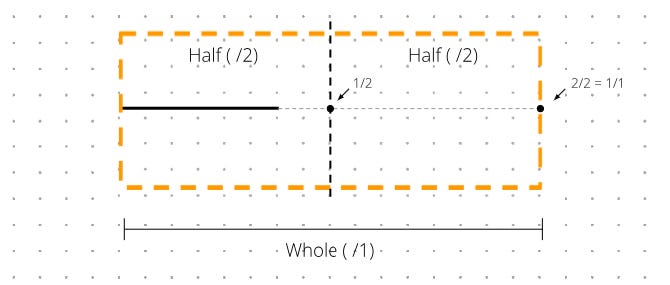
One reason for reiterating this sentence frame is that it is closer to how we talk about fractions. In the diagram above, each of the equal rectangular sections is "a half" but each can also be labeled 1/2, and it's perfectly okay to label the left rectangle 1/2 but the right one 2/2. The midpoint of the unit segment is also 1/2, by the way. Our intuitions are simpler than that, and they work well with denominators as units of measure: 'a' half is an overlayed 'thing,' a unit of measure, and one of those things is '1' half; two of 'em are two halves. We simply lean into these intuitions with the symbols: half or halves—we don't know yet—can be just /2.
Another reason for "___ are any of ___ equal parts of a whole" is that we want students to generalize—that is, to not have "number of equal parts, number of parts to count" be the way students are introduced to fractions, but rather something they pick up themselves as they see how they are represented and talked about. As an introduction, this is a procedural understanding of something that is, first, substantive to the audience; and the mismatch can cause them to understand fractions poorly, when they see them again later as just a sequence of moves and the moves don't make sense then.
The combination number-line and fraction strip(s)—or 'tape diagram' for all you keep-austin-weirdos—started as shorthand, but I like it. On another pass, though, I will want to think about whether I still like it. The combination suffers less from load issues (it seems to me) when we practice seeing these representations together, with the 'tape diagram' as changeable overlay—is what I would say right now (research connections, questions, and ideas are a whole other pass). But the number line representation gains strength from the main context of this story: measuring a length precisely.
The subtext throughout is that fraction sizes get smaller as denominators (going down on the page; important now and later) get bigger—trying to get more precise (the 'error' [distance between the end of the line segment and the closest nth] is a fight between the grid density, which increases smoothly, and the phase alignment for lack of a better term, which is erratic).
Other mentionables: n/n = 1/1 is reinforced over and over, mixed numbers quickly, just to get out the construction for now, and estimation! Story choices are sometimes there in one pass just so we can remember to deal with them more fully in another.