
On Laughter
What It Is, Why We Do It

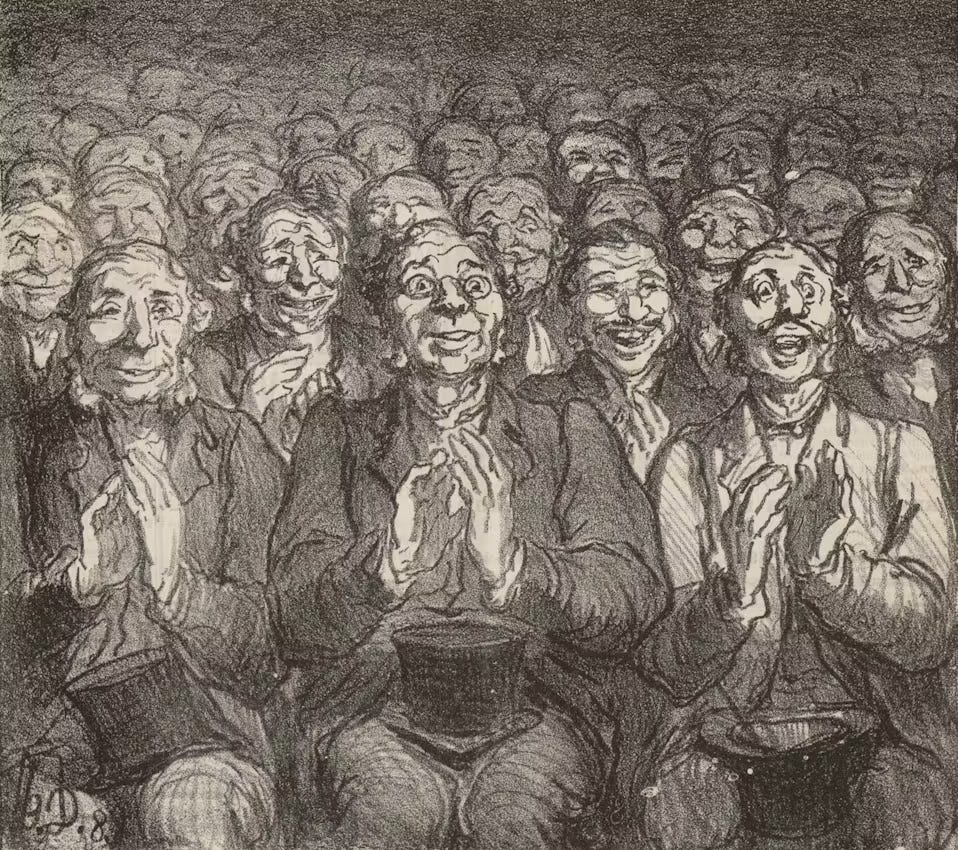
I have written a paper that sketches out a theory of consciousness. The analysis below is derived from that work.
Imagine you're at a party for a dear, old, respected friend. Unfortunately, this friend is boring to talk with. Still, you don't want to be rude. So you try to pay attention. As you chat about the weather in Miami for fifteen minutes straight, your friend mentions that it actually snowed a little last week. You know this to be false, but you still put on your best 'I believe you' response. As long as you and your friend 'share' this view—that is, he says that it snowed a little last week, you are aware of this view, he knows you are aware of this view, you agree with the view, and he knows you agree with the view, etc., you have formed a joint-representation (an interlocked set of puzzle pieces). You can feel the commitment to this view that comes along with joint-representation if you imagine that, later, as you nurse your drink at the table, you hear, from the distant bar, "It didn't snow last week in Miami, you old coot. This is Miami!" As you raise your head, you can now see the old friend, seemingly trying to defend his view, muttering something you can't hear, but looking and gesturing in your direction. Gulp.
Now imagine—resetting to the conversation with your friend—that, as you are chatting about the weather, you lean to the side furtively and catch the glance of another of your friends. When you lock eyes, you make a quick, over-the-top, "so boring" face and then quickly, almost cartoonishly, reset your face for a conversation with the old respected friend. As you quickly look back to your other friend, you see that she is laughing. You and your laughing friend have formed an inferential-emotional-alignment, just like the 'Miami commitment' in some ways, but very importantly not the same thing at all.
If the joint-representation is "It snowed in Miami last week" (even though, recall, one party does not believe it), then the inferential-alignment may be, in part, "The person who made the face is bored. She is trapped because she is polite and the person with whom she's conversing is known to be boring but he's the respected guest of honor." The somewhat sudden inferential alignment creates a problem for the listener: did we just create a commitment? She signals her joy at the rush of inferential closeness to you along with her suggestion that this closeness is not 'serious' enough to be a commitment: two views are maintained. This is why she laughs. It's why all species laugh—to indicate that the interaction should not induce commitments to the inferred view. If we are 'play fighting' to rehearse our hunting skills, the inferred view may be that 'we are trying to kill each other.' Laughter indicates that we should not or do not agree to this view—it's just pretend.
The two-sidedness of laughter (affiliative but non-binding) makes a lot of sense of the way humans use and experience it in daily life. Nervous laughter seems to be, for example, a different beast from your friend laughing at your "so bored" face. But we can explain it in the same way. After a doctor greets a patient in an exam room, the patient may chuckle nervously when responding, indicating (possibly), 'there's a set of aligned inferences between us, I believe, and I either don't know how to conversationalize the inferences to a shared joint-representation or I'd rather not, since it's awkward and embarrassing (probably both). Let's maybe keep ourselves on our individual sides of this event. You're the doctor and I'm the patient. I'll submit to the weird thing that's going to happen next (I laugh, in part, to propose a greater closeness with the doctor), but while my laugh is affiliative, I don't want to be too close.' The doctor may reciprocate with a small laugh, which would demonstrate a 'kind' of agreement on the felt-to-be-shared inferences. The doctor may also instead choose to resist laughing, as if to say (maybe), "This may be awkward and embarrassing for you, but I do this all the time, and it's a serious thing."
Laughing flatly at a serious request has the same structure as well: "Do you want to get a cup of coffee?" "Ha ha ha! Are you asking me out?" The laugh indicates sudden 'supposed' (that may not have been his intent) inferential alignment, perhaps expressed as sympathy, and increased closeness (familiarity), but it also indicates—or may indicate—an initial desire to maintain separateness. The specific mix of feelings of alignment and those of maintaining separateness are more or less personal to the listener. If alignment overwhelms, the response may be closer to "Aww." If separateness does, the "hell no" aspect of the laugh can be implicated by the speaker and inferred by the listener.
In the examples we have looked at of inferential-emotional alignments ("so bored," awkward procedure in the exam room, potential suitor request), there are two other characteristics that, when added to this alignment, seem to be often necessary for laughter: suddenness and subversiveness. But, in fact, only suddenness really needs to be brought in, because inferential-emotional alignments can already be considered subversive—to the joint-representational plane. The parties to our examples chose to try to do their communicative work on this 'joint-inferential-emotional-alignment plane,' if you will, precisely to be subversive—to "talk" about things that you don't really talk about on the joint-representational plane (like how you're boring to talk with, old friend; or the details of getting a prostate exam; or, sorry, but I think you're ugly). That leaves suddenness: human laughter is the sound used to mark the sudden formation of a (subversive) communicatively uncommitted inferential-emotional alignment rather than a joint-representation.
Why are fart sounds funny, even completely 'out of context'? Well, we first have to remember that joint-inferential-alignment doesn't require two people to work (like joint representation does). It can be one person—and a noise. What (nearly universal?) 'subversive' inference do we draw from that distinctive "noise event" when we're just listening to it? We can be aided now in our search with the structure of laughter: sudden, subversive, inferential, affiliative, alignment that is marked (by the laugh) to indicate uncommittedness or unseriousness. What is affiliative about a fart noise? Well, that we all (depending on what you're thinking at the time, humans, dogs, whatever) make similar noises. The fart noise is a perfect match to our standing inference about people yet one that, by our laughing, we separate ourselves from in a social way. Inferential affiliation is suddenly strengthened (we're all farters), but we laugh to communicate the non-formation of a commitment, which is done in any number of ways and for different social reasons.
What the laugh communicates is in essence the opposite of what a joint-representation communicates: un-serious, un-committed, un-conversationalized—un-possible on the joint-representational plane.